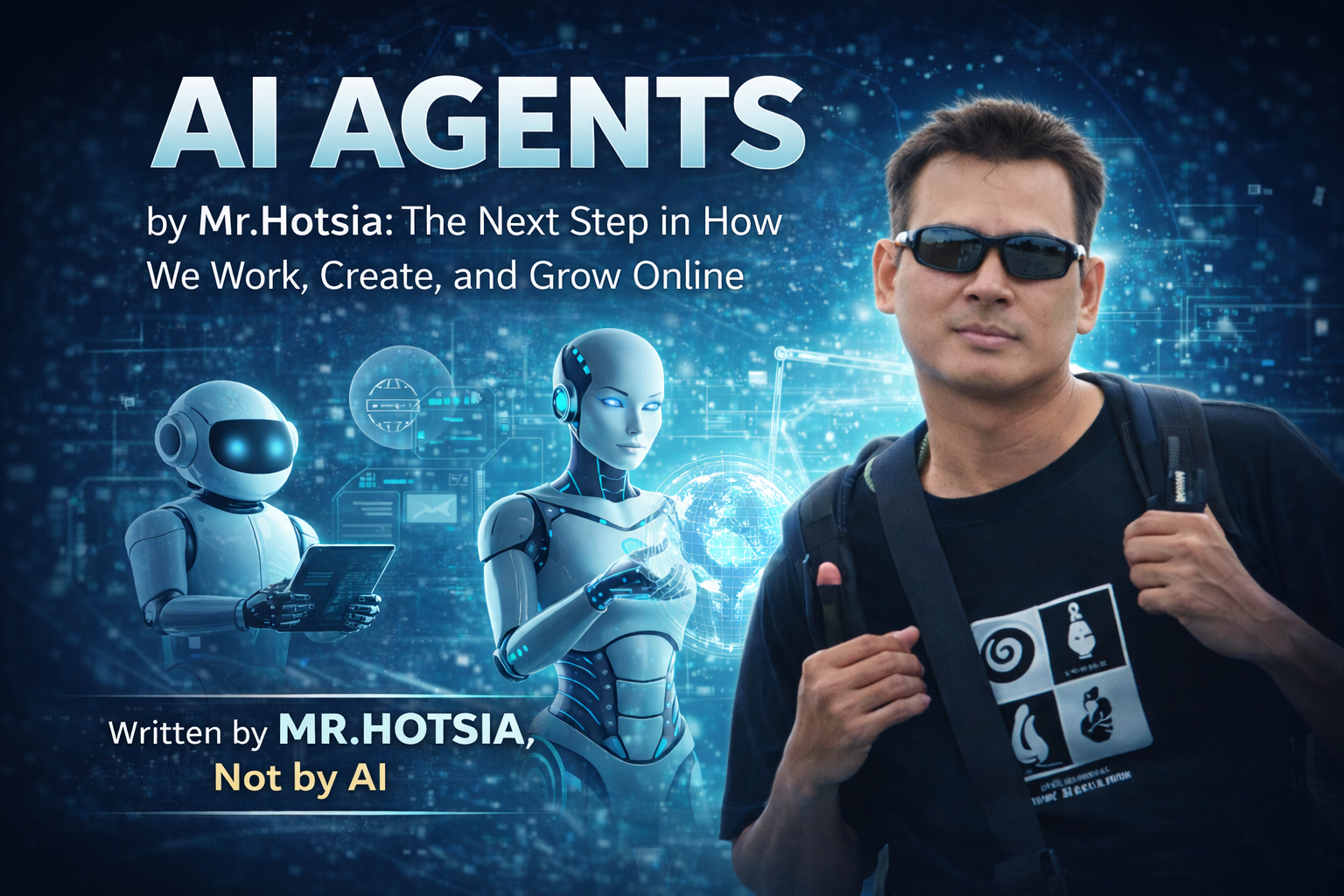
What Industries Use AI Agents? A Practical Review by mr.hotsia 🤖🏭
By mr.hotsia
This article is written by mr.hotsia, a long term traveler and storyteller who has explored Thailand, Laos, Vietnam, Cambodia, Myanmar, India and many other Asian countries. Through years of travel, online business experience, and digital publishing, he has learned how technology keeps changing the way people live and work. On his YouTube channel followed by over a million followers, he shares ideas, stories, and practical insights in a simple style that everyday readers can enjoy and understand.
Introduction: AI Agents Are Moving Into the Real World
Artificial intelligence is no longer just a topic for scientists, giant software companies, or futuristic movies. It is becoming part of real business operations, everyday customer experiences, and digital workflows across many industries. One of the most important developments in this shift is the rise of AI agents.
Many people have heard about AI chatbots, writing tools, or image generators. But AI agents are a little different. They are built to do more than answer one question at a time. In many situations, they can help organize tasks, follow instructions, gather information, support decision making, and carry out multi step digital work with less human effort.
That is why more industries are paying attention.
The big question is not whether AI agents are being used. They already are. The more useful question is this: What industries use AI agents, and how are they actually using them?
This review takes a practical look at that question. Instead of talking in vague futuristic language, let us explore the industries where AI agents may already be making work faster, smarter, and more efficient.
What Is an AI Agent in Practical Terms?
Before diving into industries, it helps to define the term in a simple way.
An AI agent is a digital system that can take a goal and move through steps to help complete that goal. It may gather information, respond to users, organize tasks, make suggestions, or interact with digital tools. In some cases, it can do one small job repeatedly. In other cases, it can handle more complex workflows.
Think of a normal AI assistant as a helpful receptionist. An AI agent is closer to a capable office worker that can receive instructions, sort documents, draft responses, check details, and come back with a clearer result.
Different industries use AI agents in different ways. A hospital may use them for appointment support. A retailer may use them for customer service. A marketing team may use them for content planning. A financial company may use them to organize data and detect unusual patterns.
The industry changes, but the core idea stays similar: use AI to support work that is repetitive, information heavy, or time sensitive.
1. Customer Service and Support
One of the clearest industries using AI agents is customer service.
This area is a natural fit because many support tasks repeat every day. Customers ask similar questions, request updates, need account help, or want guidance through common processes. AI agents may help handle these interactions more quickly.
Examples include:
- answering product questions
- helping users reset passwords
- checking order status
- routing complex requests to human teams
- summarizing previous customer conversations
- preparing draft replies for support staff
The value here is not just speed. It is also consistency. AI agents may help deliver the same useful response structure to thousands of users without tiring.
Of course, human staff are still important for complex emotional cases, complaints, or unusual situations. But for basic support, AI agents are already changing the shape of the work.
2. Healthcare Administration and Patient Support
Healthcare is another industry where AI agents are gaining attention, especially on the administrative side.
This does not mean AI should replace doctors or medical judgment. That would be too simplistic and risky. But healthcare systems often involve huge amounts of scheduling, documentation, reminders, and information organization. This is where AI agents may help.
Possible uses include:
- appointment scheduling
- follow up reminders
- patient intake guidance
- insurance form support
- basic FAQ handling
- organizing non emergency communications
- summarizing administrative notes
Hospitals, clinics, and digital health platforms may benefit from tools that reduce paperwork pressure and improve communication flow. In environments where staff are overloaded, even a small improvement in routine tasks may help a lot.
Still, this is an area where careful review matters. Health related communication needs accuracy, privacy awareness, and strong human oversight.
3. Finance and Banking
The finance industry has strong reasons to explore AI agents. It handles large volumes of data, frequent customer interactions, compliance processes, and ongoing monitoring.
AI agents may support finance teams in areas such as:
- customer account assistance
- fraud monitoring support
- transaction pattern analysis
- document summarization
- internal workflow assistance
- answering common banking questions
- helping teams review reports
In banking and finance, time matters. Accuracy matters. Patterns matter. These are all areas where intelligent systems may provide useful support.
For example, an AI agent may help organize incoming client requests, identify common issues, prepare summaries for staff, or flag unusual account activity for further human review.
This does not mean the industry should trust AI without checks. Quite the opposite. Finance requires control, auditing, and accountability. But within those boundaries, AI agents may support faster operations and clearer information handling.
4. Retail and E-Commerce
Retail is one of the busiest testing grounds for AI tools, and AI agents fit naturally into this world.
Retail businesses deal with product catalogs, inventory updates, customer questions, promotions, recommendations, and after sales support. That creates many opportunities for AI agents to help.
Common retail uses may include:
- product recommendation support
- size or feature comparisons
- automated customer answers
- order tracking help
- return and refund guidance
- review summarization
- category organization
- internal inventory assistance
For e-commerce sellers, speed and convenience can shape sales outcomes. Shoppers often want immediate answers. If an AI agent can guide them clearly, that may support better user experience and smoother buying journeys.
Retail teams may also use AI agents behind the scenes. For example, an agent may help prepare product descriptions, group customer feedback, or generate campaign ideas for seasonal promotions.
5. Marketing and Advertising
Marketing is one of the most visible industries using AI agents today.
This makes sense because marketing involves planning, research, writing, segmentation, testing, and repetitive content workflows. AI agents may help reduce time spent on those tasks and support faster creative output.
Possible uses include:
- keyword and topic research
- content outline creation
- ad copy drafting
- customer persona summaries
- campaign workflow planning
- email sequence support
- performance summary preparation
- idea generation for blogs, video scripts, and landing pages
For solo marketers, affiliate marketers, agencies, and internal brand teams, AI agents may act like a fast digital helper that never gets tired of first drafts.
Still, quality control is essential. Marketing is not only about speed. It is also about brand tone, trust, audience understanding, and compliance. An AI generated draft may save time, but human editing still shapes the final value.
6. Education and Online Learning
Education is another industry where AI agents are starting to matter more.
Teachers, students, tutors, and learning platforms all deal with information delivery, question answering, lesson planning, and progress support. AI agents may help make these processes more interactive and personalized.
Possible uses include:
- answering common student questions
- guiding learners through lessons
- creating practice materials
- summarizing textbooks or notes
- helping with scheduling or reminders
- generating study outlines
- supporting language practice
- explaining concepts in simpler words
For online learning platforms, AI agents may act like patient digital tutors that can respond at any hour. For teachers, they may reduce time spent on repetitive preparation. For students, they may support learning in a more flexible way.
Of course, real teaching still benefits from human connection, empathy, and professional judgment. But AI agents may support the system around that human core.
7. Travel and Hospitality
Travel and hospitality are full of questions, changes, and service moments. That makes them another strong industry for AI agents.
Hotels, airlines, tour providers, and booking platforms often handle similar requests again and again. Customers ask about bookings, changes, check in times, baggage policies, room types, destinations, and activity options.
AI agents may help with:
- reservation support
- itinerary suggestions
- travel FAQ handling
- local information summaries
- customer message organization
- multi language communication support
- follow up reminders
- review analysis
In travel, timing is everything. When guests are on the move, they want quick answers. AI agents may support smoother communication and reduce waiting time.
For hospitality brands, this may improve service flow. For travelers, it may reduce stress. For small operators, it may provide a more professional digital presence even with limited staff.
8. Real Estate
Real estate is another industry that may benefit from AI agents, especially in customer communication and information handling.
Agents and agencies often deal with repeated questions from buyers, renters, and sellers. Properties have many details. Leads come in from different channels. Documents and follow ups can become time consuming.
Possible uses include:
- answering property questions
- scheduling viewings
- qualifying leads
- summarizing listing features
- drafting follow up messages
- organizing inquiry history
- comparing property options
- preparing simple market summaries
An AI agent may help a real estate business look more responsive, especially during the early stage of customer interaction. It can support speed while the human team focuses on negotiation, trust building, and final decisions.
9. Manufacturing and Supply Chain
When people hear AI, they often imagine screens and software. But manufacturing and supply chain operations also have strong use cases for AI agents.
These industries rely on coordination, reporting, scheduling, forecasting, and issue tracking. AI agents may help organize information and support quicker operational awareness.
Possible uses include:
- maintenance reminder support
- inventory and supply status summaries
- shipment communication assistance
- production report drafting
- anomaly detection support
- workflow alerts
- internal knowledge retrieval
- supplier communication preparation
Manufacturing environments need efficiency. Supply chains need visibility. AI agents may help teams spot patterns, organize updates, and reduce communication friction across departments.
10. Human Resources and Recruiting
HR teams manage hiring, onboarding, training support, internal communication, and employee questions. Much of this involves recurring information tasks, which makes HR another industry where AI agents may help.
Possible uses include:
- answering internal policy questions
- helping candidates with application steps
- screening basic information
- scheduling interviews
- onboarding checklist guidance
- training material summaries
- internal FAQ support
- employee workflow reminders
Recruiting teams may also use AI agents to summarize applications, organize candidate information, or prepare communication drafts. This may reduce routine workload and allow HR professionals to spend more time on people focused decisions.
As with other industries, fairness and oversight matter. Hiring decisions should not be handed carelessly to automation. But support tasks around recruiting can be an area where AI agents add practical value.
11. Legal and Professional Services
Law firms, consulting teams, and other professional service industries also handle large amounts of documents, research, communication, and structured information. This creates opportunities for AI agents to support routine workflows.
Possible uses include:
- document summarization
- client intake support
- scheduling and reminder management
- research assistance
- internal knowledge search
- draft preparation for standard communications
- meeting note organization
This is not the same as replacing legal professionals. It is about reducing friction in information heavy work. Professional services rely on expertise, but even experts spend time on repetitive preparation. AI agents may support that layer.
12. Media, Publishing, and Content Creation
The media world moves fast. Writers, editors, researchers, publishers, and creators constantly work with ideas, deadlines, structure, formatting, and audience engagement. AI agents may help support these tasks.
Examples include:
- article outline generation
- topic research support
- transcript summarization
- headline brainstorming
- FAQ creation
- content repurposing across formats
- newsletter drafting support
- editorial workflow assistance
For creators and publishers, AI agents may reduce the drag of repetitive work while keeping more time available for original thought and storytelling.
The biggest caution here is quality. Audiences still respond best to clarity, voice, trust, and experience. AI may support production, but it should not flatten content into bland sameness.
Why So Many Industries Are Interested
Across all these industries, the same pattern appears again and again. AI agents are useful when work includes:
- repeated questions
- large amounts of text or data
- multi step processes
- time pressure
- communication at scale
- draft based workflows
- information that needs organizing
In other words, many industries use AI agents because many industries are full of digital clutter. AI agents may help tidy the desk, sort the pile, and speed up the first pass.
That is their practical charm.
Are AI Agents Replacing Entire Industries?
Not really. At least not in the simple dramatic way people sometimes imagine.
What is happening looks more like transformation than total replacement. In many industries, AI agents may take over smaller repetitive tasks while humans stay responsible for judgment, strategy, empathy, ethics, and complex decisions.
The smarter question is not “Will AI replace this industry?”
A better question is: “Which parts of this industry may be supported by AI, and which parts still need strong human control?”
That is a more realistic way to understand the shift.
Final Verdict: AI Agents Are Already Spreading Across Many Industries
So, what industries use AI agents?
The answer is broad and growing. Customer service, healthcare administration, finance, retail, e-commerce, marketing, education, travel, hospitality, real estate, manufacturing, HR, legal support, and media are all exploring or actively using AI agents in different ways.
Some use them to answer questions. Some use them to organize data. Some use them to draft content. Some use them to support workflows behind the scenes.
The exact tools may differ, but the trend is clear.
AI agents are not locked inside one field. They are becoming a cross industry support layer for the digital economy.
That is why this topic matters. It is not only about technology. It is about how modern work is being reshaped one task at a time.
For businesses, the opportunity is not to chase hype blindly. It is to ask where an AI agent may support real efficiency, better service, or cleaner workflow without sacrificing human judgment.
That is where the most useful results are likely to appear.
10 FAQs About Industries That Use AI Agents
1. What industries use AI agents the most?
Customer service, marketing, e-commerce, finance, healthcare administration, and education are among the most visible industries using AI agents today.
2. Do only big companies use AI agents?
No. Small businesses, freelancers, online stores, and independent creators may also use AI agents for writing, planning, support, and organization.
3. Can healthcare use AI agents safely?
Healthcare may use AI agents for administrative support, communication, and scheduling, but human oversight remains very important.
4. Are AI agents common in retail?
Yes. Retail and e-commerce businesses may use AI agents for product questions, customer service, order support, and recommendation workflows.
5. How does marketing use AI agents?
Marketing teams may use AI agents for content ideas, draft creation, research, campaign planning, and performance summaries.
6. Can AI agents help in education?
Yes. They may support learners and teachers through tutoring assistance, study materials, summaries, and question answering.
7. Do travel companies use AI agents?
Yes. Travel and hospitality businesses may use them for booking support, itinerary help, customer communication, and common travel questions.
8. Are AI agents replacing workers in every industry?
Not entirely. In many cases, they support repetitive tasks while humans continue to handle complex decisions and relationships.
9. Why are so many industries interested in AI agents?
Because many industries deal with repeated tasks, digital communication, information overload, and time pressure, which are all areas where AI agents may help.
10. Will more industries use AI agents in the future?
Very likely. As tools become easier to use and more affordable, adoption may continue to expand across even more sectors.

I’m Mr.Hotsia, sharing 30 years of travel experiences with readers worldwide. This review is based on my personal journey and what I’ve learned along the way. Learn more |