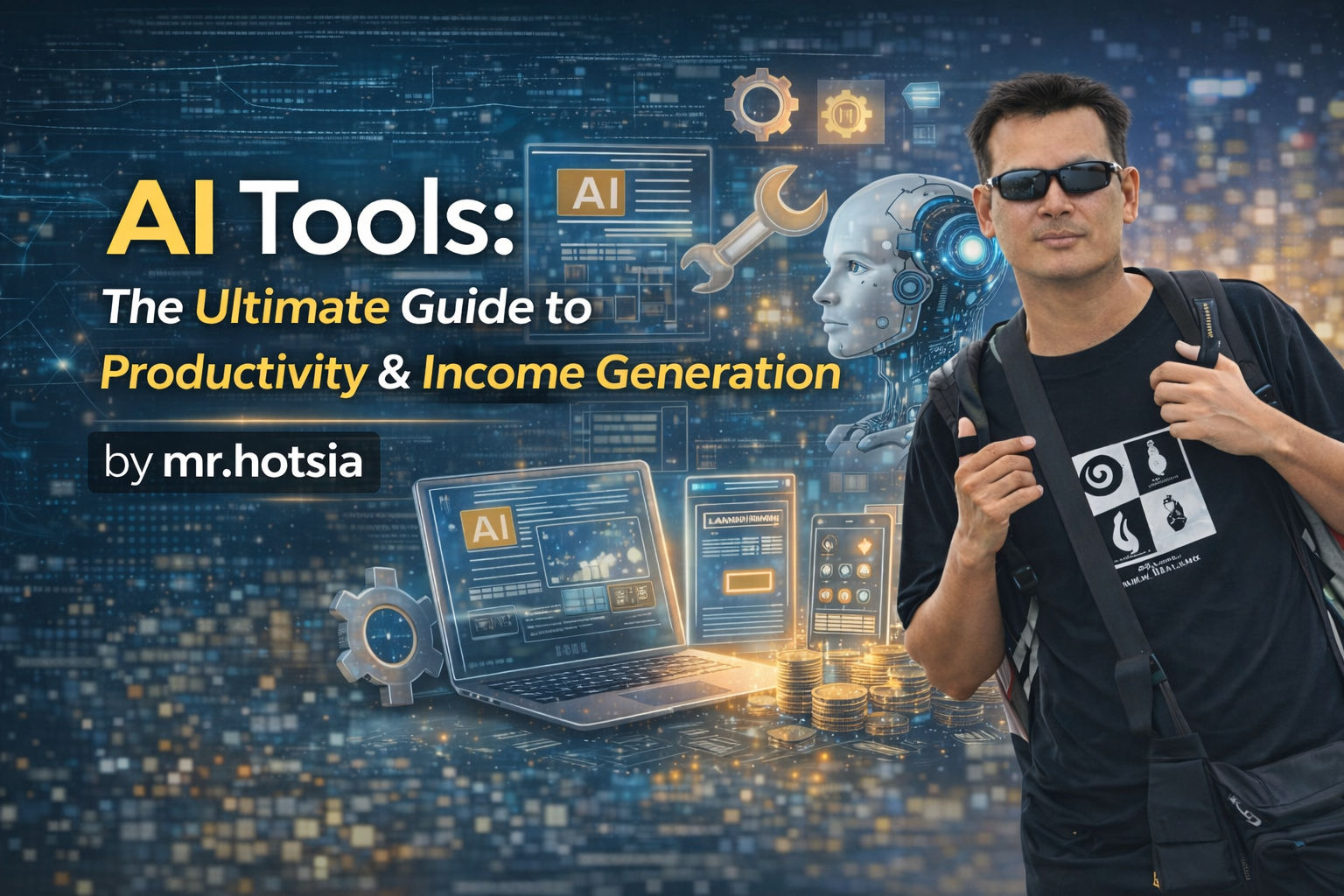
What Are AI Tools? A Practical Guide for Beginners, Creators, and Small Business Owners 🤖
This article is written by mr.hotsia, a long term traveler and storyteller with a YouTube channel followed by over a million followers. Through years of travel across Thailand, Laos, Vietnam, Cambodia, Myanmar, India and many other Asian countries, I have seen how technology changes the way people live, work, learn, and build businesses. In this article, I want to explain AI tools in a simple and practical way so readers can understand what they are, how they work, and why they matter today.
🌍 Introduction
The phrase AI tools is everywhere now. People talk about AI tools for writing, AI tools for design, AI tools for business, AI tools for customer support, AI tools for video editing, and even AI tools for schoolwork. For many beginners, the topic feels exciting but also confusing. Some people imagine robots doing everything. Others think AI is too technical and only for programmers. In reality, AI tools are often much simpler than that.
AI tools are just software tools that use artificial intelligence to help humans do tasks faster, smarter, or with less manual effort. Some tools help you write. Some help you create images. Some help you analyze data. Some help answer customer questions. Others help summarize long documents, clean up audio, translate languages, or generate ideas for content and marketing.
You do not need to be a scientist to use them. In many cases, you only need to know what you want and how to ask clearly.
This article will explain what AI tools are, the main types of AI tools, how they are used in everyday life, their benefits, their limitations, and what beginners should understand before depending on them too much.
🧠 What Does “AI” Mean?
AI stands for artificial intelligence. That means a computer system is designed to perform tasks that usually need human thinking. These tasks can include:
- understanding language
- recognizing images
- spotting patterns
- making predictions
- answering questions
- generating text, audio, images, or video
- helping with decision making
AI does not mean a machine is truly human. It does not have feelings, personal wisdom, or real life experience. Instead, it works by learning from huge amounts of data and then producing outputs based on patterns it has seen before.
So when people ask, what are AI tools?, the easiest answer is this:
AI tools are digital tools that use pattern recognition and learned models to help users complete tasks more efficiently.
🛠️ What Are AI Tools?
AI tools are applications, websites, apps, or software programs powered by artificial intelligence. Their main goal is to reduce human workload, improve speed, and support better results.
For example:
- A writing AI tool can help draft an article.
- A design AI tool can create an image from a short description.
- A customer service AI tool can answer common support questions.
- A voice AI tool can turn speech into text.
- A productivity AI tool can summarize a meeting.
Think of AI tools as assistants. They are not magic. They are not perfect. But they can be very useful.
A calculator helps with math. A search engine helps find information. In the same way, AI tools help with tasks that involve language, creativity, analysis, and automation.
📚 Main Types of AI Tools
AI tools come in many forms. Here are the main categories that most people will see.
1. AI Writing Tools ✍️
These tools help users write or improve text. They can:
- draft blog posts
- rewrite paragraphs
- improve grammar
- generate product descriptions
- write email replies
- brainstorm titles and headlines
- summarize articles
Writers, marketers, students, bloggers, and business owners often use AI writing tools to save time.
2. AI Image Generation Tools 🎨
These tools create images based on text prompts. For example, a user can type “a modern black and gold logo for a travel brand” and receive a newly generated image.
These are popular for:
- ad creatives
- blog illustrations
- thumbnails
- social media graphics
- concept art
- product mockups
3. AI Video and Audio Tools 🎥
These tools can:
- create voiceovers
- edit video faster
- remove background noise
- generate subtitles
- clone voices in some cases
- turn text into speech
- turn speech into text
This category is growing fast because content creators need speed.
4. AI Chatbots and Assistants 💬
These tools are designed to answer questions, hold conversations, explain ideas, or guide users through tasks.
They are often used for:
- customer support
- internal team help desks
- education
- coding assistance
- research support
- brainstorming
5. AI Productivity Tools 📈
These tools help people organize work. They may summarize meetings, sort notes, create task lists, analyze spreadsheets, or automate repetitive office jobs.
For teams and entrepreneurs, this category can save many hours every week.
6. AI Data Analysis Tools 📊
These tools help businesses or individuals understand information faster. They can identify patterns, make forecasts, group customer behavior, and generate reports.
Large companies use them for serious operations, but smaller businesses are using them more now too.
7. AI Coding Tools 💻
AI coding tools help programmers write, explain, debug, or improve code. Some can suggest functions or complete code blocks.
This does not mean they replace developers. But they can be useful for speeding up routine tasks.
🏪 Where Are AI Tools Used in Real Life?
A lot of people think AI tools are only for big tech companies. That is no longer true. AI tools are now used by freelancers, teachers, YouTubers, online sellers, bloggers, agencies, travel businesses, and local shops.
Here are a few examples.
Content Creation
A blogger can use AI tools to:
- brainstorm article ideas
- draft outlines
- improve readability
- create feature images
- write social media captions
E-commerce
An online seller can use AI tools to:
- generate product descriptions
- answer customer questions
- translate product pages
- create ad headlines
- improve product photos
Education
Students and teachers may use AI tools to:
- explain difficult topics
- summarize lessons
- create quizzes
- improve writing
- generate study notes
Customer Service
Businesses can use AI chat systems to:
- answer basic questions 24 hours a day
- reduce response time
- guide customers to the correct service
- collect support information before a human takes over
Travel and Hospitality
Hotels, tour sellers, and travel creators can use AI tools to:
- reply to guest inquiries
- create promotional content
- write destination guides
- improve booking descriptions
- translate communication for international customers
Small Business Operations
A local business owner can use AI tools for:
- invoices and templates
- marketing copy
- scheduling support
- social content
- data summaries
- idea generation
⚡ Why Are AI Tools So Popular?
AI tools are popular because they solve a painful problem: too much work and not enough time.
People are busy. Business owners wear many hats. Creators must produce content constantly. Support teams receive repeated questions. Writers stare at blank pages. Designers need faster drafts. AI tools help with these pressures.
Here are the biggest reasons people use them.
Speed
Many tasks that once took hours can now take minutes.
Convenience
You do not need advanced training to start using many AI tools.
Cost Savings
Some businesses use AI to reduce the need for outsourcing small repetitive tasks.
Idea Generation
AI can help when people feel stuck and need a starting point.
Automation
AI can handle repetitive actions that drain time and energy.
Accessibility
AI tools can help people write better, understand more, or create materials they may not have had the skill to make on their own.
✅ Benefits of AI Tools
AI tools can be genuinely useful when used wisely. Their main strengths include the following.
1. They Save Time
This is the biggest benefit. AI can draft, summarize, suggest, and automate much faster than manual work.
2. They Help Beginners Start Faster
Someone with limited experience in writing, design, or planning can use AI to get an early draft and improve from there.
3. They Reduce Repetitive Work
Tasks like rewriting similar emails or creating multiple content variations become easier.
4. They Can Increase Output
Businesses and creators can produce more content, more ideas, and more support responses in less time.
5. They Can Support Creativity
AI can suggest unexpected ideas, titles, angles, or formats that a user may not have considered.
⚠️ Limitations of AI Tools
Even though AI tools are powerful, they have weaknesses. This part is very important.
1. They Can Be Wrong
AI sometimes produces text that sounds confident but contains mistakes. It may misunderstand facts, mix up details, or invent information.
2. They Lack Real Judgment
AI does not truly understand consequences the way humans do. It can help, but it does not replace human judgment.
3. Output Quality Depends on Input Quality
If you ask vague questions, you may get weak answers. Good prompting matters.
4. They May Sound Generic
Some AI-generated content feels repetitive or too plain. Human editing is often needed to add personality, accuracy, and originality.
5. Privacy Matters
Users should be careful about uploading sensitive business data, personal records, or confidential information into any tool.
6. Overdependence Can Hurt Skills
If people rely on AI for everything, they may stop developing important thinking, writing, or research habits.
👀 Are AI Tools Replacing Humans?
This is one of the biggest questions people ask.
The honest answer is: AI tools are replacing some tasks, not all humans.
They are very good at repetitive, pattern based, and structured tasks. But humans still matter for:
- strategy
- emotional understanding
- trust building
- leadership
- ethics
- final decision making
- originality shaped by real life experience
A business may use AI to draft 20 product descriptions, but a human still decides the final tone and checks accuracy. A creator may use AI to outline a video, but the human personality is what keeps viewers interested.
In that sense, AI tools often work best as partners, not full replacements.
🧭 How Should Beginners Use AI Tools?
If you are new to AI tools, the best approach is simple.
Start with One Real Problem
Do not try every AI tool at once. Pick one task that wastes your time. For example:
- writing social captions
- answering repeated customer questions
- summarizing long text
- creating first draft articles
- generating image concepts
Then test one tool for that one problem.
Learn to Give Clear Instructions
The better your instructions, the better your output. Instead of saying:
“Write about AI.”
Say:
“Write a beginner-friendly article explaining what AI tools are, with practical examples for small business owners.”
Clear instructions usually produce better results.
Always Review the Output
Never copy and publish blindly. Check for:
- accuracy
- tone
- spelling
- logic
- originality
- brand fit
Use AI for Drafting, Not Blind Trust
A strong method is to let AI create the first version, then improve it yourself.
🏁 What Makes a Good AI Tool?
Not all AI tools are worth using. A good AI tool usually has these qualities:
- easy to use
- gives useful output
- saves real time
- fits your workflow
- has clear pricing
- protects user data reasonably well
- allows editing and control
- does not create more confusion than value
The best AI tool is not the one with the biggest name. It is the one that solves your real problem simply and reliably.
🔮 The Future of AI Tools
AI tools will likely become even more common in everyday life. In the future, people may use them almost like a normal office feature, similar to email, spreadsheets, or messaging apps.
We will probably see more AI in:
- business dashboards
- search systems
- shopping assistance
- video creation
- translation
- personal productivity
- education
- voice interfaces
- healthcare support systems
- financial analysis tools
But the future will also bring more discussion about ethics, copyright, privacy, and quality control. As AI grows, human responsibility becomes even more important.
🧩 Final Thoughts
So, what are AI tools?
They are software tools powered by artificial intelligence that help people create, analyze, automate, and solve problems more efficiently. They can write, draw, summarize, organize, answer questions, and support decision making. They are already changing how businesses operate and how individuals work every day.
At the same time, AI tools are not perfect. They can save time, but they still need human review. They can generate ideas, but they do not replace lived experience. They can support business growth, but only when used with care and common sense.
For beginners, the smartest path is not to fear AI and not to worship it. Instead, learn where it truly helps, test it in practical ways, and combine it with your own judgment. That is where the real value appears.
In simple words, AI tools are not just about technology. They are about helping people do more with the time, skills, and opportunities they already have.
❓ FAQs About AI Tools
1. What are AI tools in simple words?
AI tools are software programs that use artificial intelligence to help people do tasks such as writing, designing, analyzing, summarizing, or answering questions.
2. Do I need coding skills to use AI tools?
No. Many AI tools are made for regular users and do not require coding knowledge.
3. Are AI tools free?
Some AI tools offer free plans or limited free use, while others require monthly or yearly payment.
4. Can AI tools write articles?
Yes. AI tools can draft articles, outlines, and summaries, but human editing is still important for quality and accuracy.
5. Can AI tools create images?
Yes. Some AI tools generate images based on text prompts entered by the user.
6. Are AI tools safe to use for business?
They can be useful, but businesses should be careful with privacy, sensitive data, and fact checking.
7. Will AI tools replace jobs?
AI tools may reduce some repetitive tasks, but many jobs will still need human judgment, communication, and strategy.
8. What is the biggest advantage of AI tools?
The biggest advantage is saving time while helping users complete tasks faster.
9. What is the biggest weakness of AI tools?
A major weakness is that AI can sometimes produce incorrect or overly confident answers.
10. What is the best way to start using AI tools?
Start with one real problem, choose one tool, give clear instructions, and always review the results carefully.

I’m Mr.Hotsia, sharing 30 years of travel experiences with readers worldwide. This review is based on my personal journey and what I’ve learned along the way. Learn more |