What Is an AI Agent? A Practical Guide to Understanding the Brains Behind Modern Automation
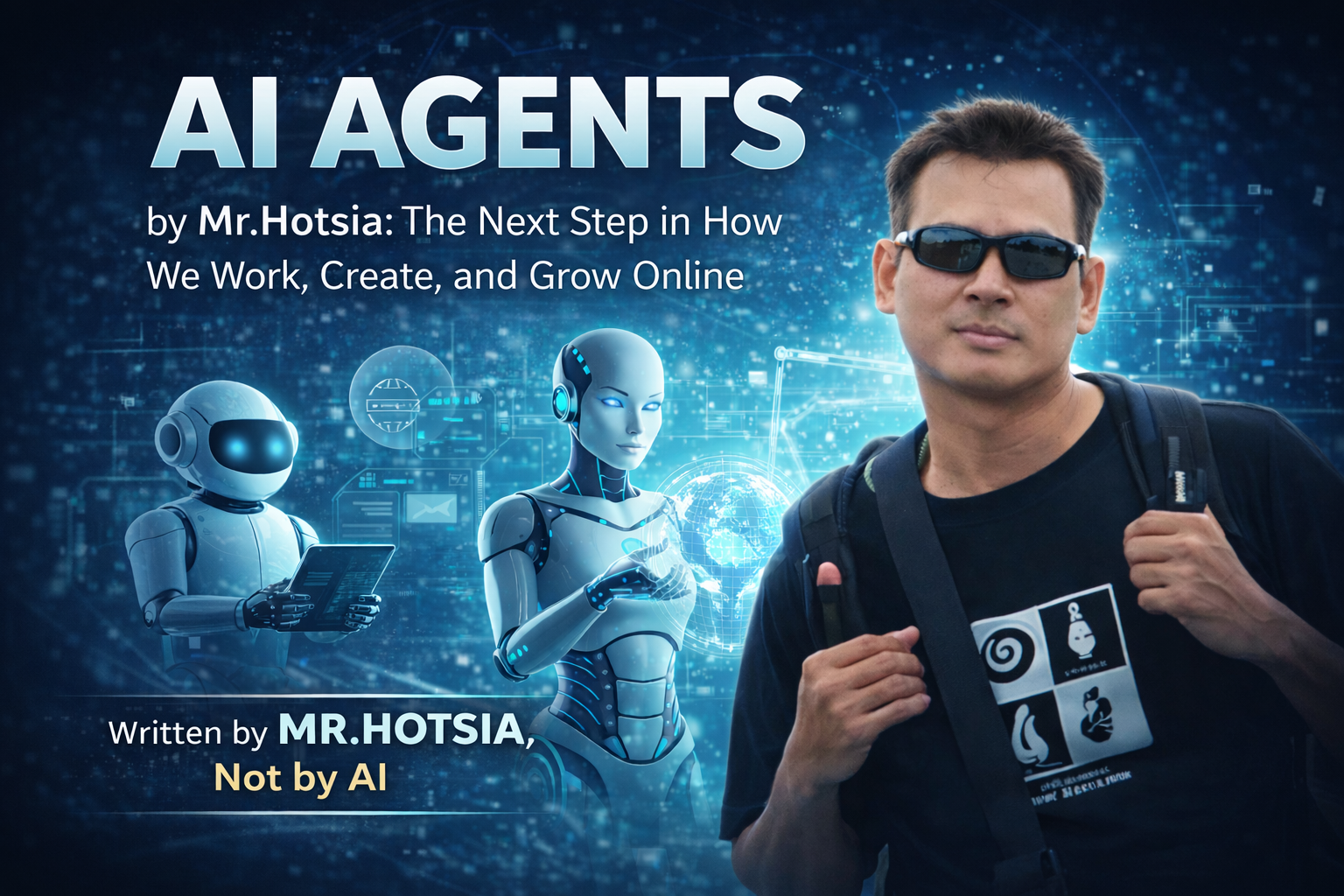
This article is written by mr.hotsia, a long term traveler and storyteller whose YouTube channel has been followed by over a million followers. Over the years, he has traveled across Thailand, Laos, Vietnam, Cambodia, Myanmar, India and many other Asian countries. Through these experiences, he has observed how technology quietly transforms everyday life. From simple tools to advanced systems, each wave of innovation has one goal: to make decisions faster, smarter, and more efficient. Today, one of the most important concepts driving this transformation is the idea of the AI agent.
Introduction
Artificial intelligence is no longer just a buzzword. It is becoming part of daily life, business operations, and digital ecosystems. Yet, many people still think of AI as a single tool, like a chatbot or an image generator.
In reality, modern AI is moving beyond simple tools into something more dynamic.
This is where AI agents come in.
An AI agent is not just a program that answers questions. It is a system designed to take actions, make decisions, and complete tasks based on goals. Instead of waiting for instructions every time, it can operate with a level of autonomy.
Understanding AI agents is important because they represent the next step in automation. They are the difference between asking a tool to do something and having a system that works for you continuously.
What Is an AI Agent?
An AI agent is a software system that can perceive its environment, process information, and take actions to achieve a specific goal.
In simpler terms, an AI agent is like a digital assistant that does not just respond, but acts.
It typically has three core components:
- Input (Perception): It receives data from its environment
- Processing (Decision-Making): It analyzes the data using algorithms or models
- Output (Action): It takes action based on its analysis
For example, a simple AI chatbot responds when you ask a question. But an AI agent can go further. It can monitor your needs, perform tasks, and adjust its actions based on results.
How AI Agents Work
AI agents operate in a loop:
- Observe the environment
- Analyze the situation
- Decide on the best action
- Execute the action
- Learn or adjust based on outcomes
This loop allows them to improve over time and adapt to changing conditions.
Unlike traditional software, which follows fixed instructions, AI agents can handle uncertainty and variability.
Types of AI Agents
There are several types of AI agents, depending on their complexity.
1. Simple Reflex Agents
These agents react directly to inputs without memory. They follow predefined rules.
Example:
A thermostat that turns on heating when the temperature drops.
2. Model-Based Agents
These agents maintain an internal model of the environment. They can make better decisions because they “remember” past states.
3. Goal-Based Agents
These agents act to achieve specific goals. They evaluate different actions based on how well they help reach the goal.
4. Utility-Based Agents
These agents choose actions based on maximizing a utility function, such as efficiency, profit, or satisfaction.
5. Learning Agents
These agents improve over time by learning from experience. Many modern AI systems fall into this category.
Real-World Examples of AI Agents
AI agents are already part of everyday life, even if many people do not notice them.
Digital Assistants
Tools like virtual assistants can schedule tasks, answer questions, and manage daily activities.
E-commerce Recommendations
Online stores use AI agents to suggest products based on user behavior.
Customer Support Systems
AI agents handle inquiries, route tickets, and provide automated responses.
Trading Systems
Some platforms use AI agents to analyze markets and execute strategies based on data.
Smart Home Systems
Devices can adjust lighting, temperature, and security based on user patterns.
Why AI Agents Matter
AI agents are important because they reduce the need for constant human input.
Instead of:
- Doing tasks manually
- Repeating the same actions
- Monitoring systems continuously
You can delegate these tasks to AI agents.
This creates several advantages:
Efficiency
Tasks are completed faster and more consistently.
Scalability
One agent can handle multiple processes at once.
Consistency
Decisions are based on data, not emotion.
Availability
AI agents can operate 24/7 without interruption.
AI Agents in Business
Businesses are increasingly adopting AI agents to improve operations.
Marketing
AI agents can:
- Generate content
- Analyze customer behavior
- Optimize campaigns
Sales
They can:
- Qualify leads
- Send follow-ups
- Personalize communication
Operations
AI agents can:
- Automate workflows
- Manage inventory
- Predict demand
Customer Experience
They provide:
- Instant responses
- Personalized recommendations
- Continuous support
AI Agents vs Traditional Automation
Traditional automation follows fixed rules.
AI agents go beyond that.
| Feature | Traditional Automation | AI Agents |
|---|---|---|
| Flexibility | Low | High |
| Learning | No | Yes |
| Decision-Making | Limited | Advanced |
| Adaptability | Static | Dynamic |
This difference is what makes AI agents more powerful.
Challenges and Limitations
While AI agents offer many advantages, they are not perfect.
Data Dependency
They rely on data quality. Poor data can lead to poor decisions.
Complexity
Building advanced agents requires technical expertise.
Ethical Concerns
Issues such as privacy and bias need careful consideration.
Over-Reliance
Users should avoid depending entirely on automation without oversight.
mr.hotsia Perspective
From my own experience, I have seen how tools evolve over time.
In the past, we used basic software to assist with tasks. Everything required manual control. You had to click, type, and decide every step.
Now, the shift is clear.
We are moving toward systems that act.
AI agents represent that shift.
They are not just tools you use. They are systems that work alongside you.
For example, when creating content or managing online platforms, the workload can become repetitive. Writing, posting, analyzing, and optimizing can take hours.
With AI agents, many of these steps can be supported or automated.
But one thing remains important.
Human judgment.
AI agents can assist, but they should not replace thoughtful decision-making. The best results often come from combining automation with experience.
The Future of AI Agents
AI agents are still evolving.
In the future, we may see:
- More personalized agents tailored to individual users
- Systems that collaborate with each other
- Greater integration across platforms
- Improved learning capabilities
The direction is clear.
AI is becoming more autonomous.
Practical Tips for Beginners
If you are new to AI agents, here are some simple steps:
Start Small
Use simple tools to understand how automation works.
Focus on One Task
Choose a specific process to automate.
Learn Basic Concepts
Understanding inputs, outputs, and workflows helps.
Test and Adjust
Experiment and refine your approach.
Stay Informed
AI is evolving quickly, so continuous learning is important.
Final Thoughts
AI agents represent a major shift in how technology is used.
They move beyond simple tools and into systems that can act, decide, and adapt.
For individuals and businesses, this creates opportunities to:
- Save time
- Improve efficiency
- Scale operations
At the same time, it is important to approach this technology with realistic expectations.
AI agents are powerful, but they are not perfect.
They are best used as partners in decision-making, not replacements for human insight.
Understanding how they work is the first step toward using them effectively.
FAQs
1. What is an AI agent?
An AI agent is a system that can perceive, decide, and act to achieve specific goals.
2. How is it different from a chatbot?
A chatbot responds to input, while an AI agent can take actions and complete tasks.
3. Are AI agents difficult to use?
Basic agents are easy to use, but advanced systems may require learning.
4. Can AI agents learn over time?
Yes, many modern agents improve based on experience.
5. What industries use AI agents?
Many industries including marketing, finance, healthcare, and technology.
6. Are AI agents expensive?
Costs vary depending on complexity and usage.
7. Can AI agents replace humans?
They assist humans but do not fully replace human decision-making.
8. Are they safe to use?
They are generally safe, but users should be aware of data and ethical considerations.
9. How can I start using AI agents?
Begin with simple tools and gradually explore more advanced options.
10. Why are AI agents important?
They help automate tasks, improve efficiency, and support better decision-making.

I’m Mr.Hotsia, sharing 30 years of travel experiences with readers worldwide. This review is based on my personal journey and what I’ve learned along the way. Learn more |